One personal pattern
The visitor’s own design stays present from the drawing grid to the room and the final download. The spatial reveal belongs to something they made.
 Salon FormatAll projects
Design a pattern. Step inside it.
An invitation to discover the Wiener Werkstätte through making.
Independent working prototype · German & English
The Wiener Werkstätte brought artists and craftspeople together in Vienna in 1903. Its work ranged from fabrics and furniture to tableware and entire interiors. I wanted visitors to feel that connection through a small act of making, before introducing the history behind it.
Each step grows out of something the visitor has just done.
Choose a shape, colour and rotation. Paint across a small grid. The repeated pattern changes immediately.
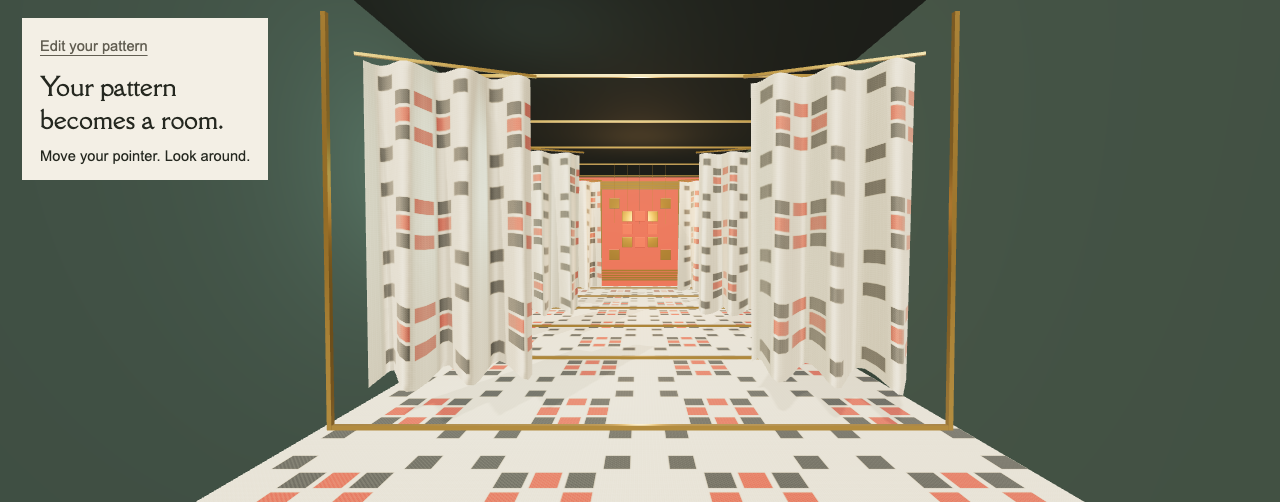
The flat sheet separates into hanging panels as the floor unfolds and a room takes shape.
Try paper, fabric and metal. Compare their edges, folds and reflections; change the scale of the pattern.
Meet the women who helped shape the workshop and discover the idea of the Gesamtkunstwerk.
Download your own pattern as a printable image.
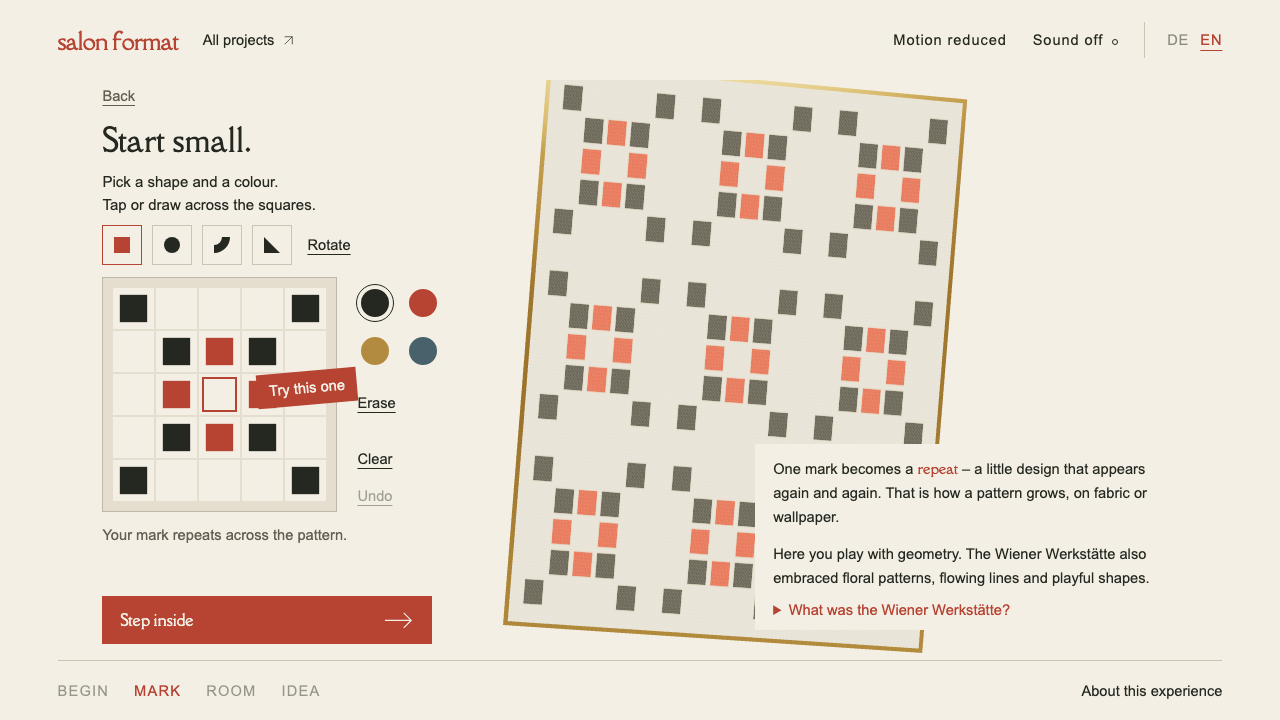
The repeated design makes a rapport visible. The room shows how a pattern can connect objects and surfaces. Material changes make the relationship between design and craft easier to notice.
These are learning intentions, not measured outcomes. The next step is testing the experience with people who have not seen it before.
The grid is a starting point, not a complete portrait of the Wiener Werkstätte. The experience also introduces floral motifs, free forms and the work of Mathilde Flögl, Felice Rix-Ueno and Vally Wieselthier.
It also makes space for a less comfortable fact: carefully handcrafted objects were often expensive and mostly accessible to wealthy customers.
The visitor’s own design stays present from the drawing grid to the room and the final download. The spatial reveal belongs to something they made.
Paper has curled edges, fabric falls into folds, and metal catches moving light. The difference is visible in shape and surface.
Controls sit below the room. Desktop screens keep the next action visible; the mobile editor scrolls above its entry button.
Reduced motion skips the unfolding sequence. Short drawing taps, rustles and metallic resonances respond to the interaction when sound is switched on. The interface is bilingual, and a flat pattern view is available when WebGL cannot run.
A self-initiated project by Isabella Kohout / Salon Format, bringing together research, writing, interaction design and an interactive browser prototype.
Original procedural patterns and spaces were created for the experience. Build checks and browser checks covered desktop and mobile viewports; real-device user testing and external historical review remain next steps.
Formgefühl was created independently by Salon Format, without collaboration with a museum. It is a contemporary interpretation, not a reconstruction of a historical room or artwork.
Historical sources and design references are documented in the project repository.
Try Formgefühl